|
ELECTRIC CARS
AUTOMOTIVE A TO Z CLIMATE CHANGE A TO Z CONTACTS EVENTS GROWTH A-Z PLEASE USE OUR SITE INDEX TO NAVIGATE THIS SITE |
||||||||||||||||||||||||||||||||||||||||||||||||||||||||||||||||||||||||||||||||||||||||||||||||||||||||||||||||||||||||||||||||||||||||||||||||||||||||||||||||||||||||||||||||||||||||||||||||||||||||||||||||||||||||||||||||||||||||||||||||||||||||||||||||||||||||||||||||||||||||||||||||||||||||||||||||||||||||||||||||||||||||||||||||||||||||||||||||||||||||||||||||||||||||||||||||||||||||||||||||||||||||||||||||||||||||||||||||||||||||||||||||||||||||||||||||||||||||||||||||||||||||||||||||
|
Battery
electric vehicles or BEVs
are electric vehicles whose main energy storage is in the chemical
energy of batteries. BEVs are the most common form of what is defined by
the California Air Resources Board
(CARB) as zero emission (ZEV)
passenger automobiles, because they produce no emissions while being
driven. The
electrical energy carried onboard a BEV to power the motors is obtained
from a variety of battery chemistries arranged into battery
packs. For additional range genset trailers or pusher trailers are
sometimes used, forming a type of hybrid vehicle. Batteries used in
electric vehicles include "flooded" lead-acid, absorbed glass
mat, NiCd, nickel metal hydride, Li-ion, Li-poly and zinc-air batteries. Thomas
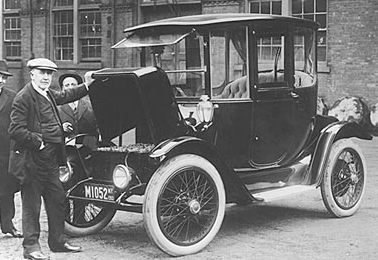
Edison - 1912 Detroit Electric While
hybrid vehicles apply many of the technical advances first developed for
BEVs, they are not considered BEVs. Of interest to BEV developers,
however, is the fact that hybrid vehicles are advancing the state of the
art (in cost/performance ratios) of batteries, electric motors,
chargers, and motor controllers, which may bode well for the future of
both pure electric vehicles and the so called "plug-in
hybrid". BEVs
were among the earliest automobiles, and before the preeminence of
light, powerful internal combustion engines, electric automobiles held
many vehicle land speed and distance records in the early 1900s. Most
notable was perhaps breaking of the 105.88 km/h (65.79 mph)
speed barrier by Camille
Jenatzy on 29.4 1899 in his rocket-like EV named La Jamais
Contente. This was the first world record over 100 km/h. BEVs
were produced by Anthony Electric, Baker
Electric, Detroit Electric, and others and at one point in history
out-sold gasoline-powered vehicles. Some
feel that the introduction of the electric starter by Cadillac
in 1913, which simplified the difficult and sometimes dangerous task of
starting the internal combustion engine, was the downfall of the
electric vehicle, as 1912 may have been the pinnacle year for BEVs.
Still others point out that it was radiators, in use as early as 1895 by
Panhard-Levassor in their
Systeme Panhard design,
which allowed engines to keep cool enough to run for more than a few
minutes, before which they had to stop and cool down at horse troughs
along with the steamers
to replenish their water supply. The truth may be that EV's had fallen
out of favor over the mass produced Ford
Model-T which went into production four years earlier in 1908. X1
electric car v Lamborghini Production
and conversion battery electric vehicles typically achieve 0.3 to 0.5 kWh
per mile (0.2 to 0.3 kWh/km). The U.S. fleet average of 23 mpg of gasoline is equivalent to 1.46 kWh/mi
and the 70 mpg Insight gets 0.48 kWh/mi (assuming 33.6 kWh per
U.S. gallon of gasoline), so battery electric cars vehicles are
relatively efficient. When comparisons are made for the total energy
cycle, the efficiency figures for BEVs drop, but such calculations are not
commonly offered for ICE vehicles (e.g. the loss of efficiency from
energy used to produce specialized fuels such as gasoline as compared to
the raw energy available from crude oil or natural gas. CO2
emission comparisons [5]
are one good indication of the current grid-mix vs gasoline consumption.
Such comparisons include production, transmission, charging, and vehicle
losses. The CO2 emissions can improve for BEVs through the
use of sustainable grid or local resources but are essentially fixed for
gasoline vehicles. Unfortunately the EV1, Ranger EV, EVPlus, and other
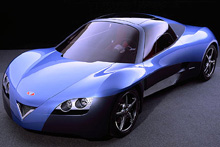
production vehicles are missing from this site. Venturi
Fetish production electric 0-100km/h in 4.5 secs RAV4-EV
vs Gas RAV4
2000
Toyota RAV4-EV 4.1 short tons CO2 (104 mpg)
2000
Toyota RAV4 2wd 7.2 short tons CO2 (26 mpg)
Other
BEVs
2000
Nissan Altra EV 3.5 short tons CO2
2000
Nissan Altra EV 3.5 short tons CO2
2002
Toyota RAV4-EV 3.8 short tons CO2
2002
Ford Explorer 7.8 short tons CO2 (USPS)
Hybrids
2000
Honda Insight 3.0 short tons CO2
2001
Honda Insight 3.1 short tons CO2
2005
Toyota Prius 3.5 short tons CO2
2005
Ford Escape H 2x 5.8 short tons CO2
2005
Ford Escape H 4x 6.2 short tons CO2
Standard
ICE vehicles
2005
Dodge Neon 2.0L 6.0 short tons CO2
2005
Ford Escape 4x 8.0 short tons CO2
2005
GMC Envoy XUV 4x 11.7 short tons CO2 It
is important to study the full effect of any vehicle design, especially
when promoted as better than the status quo. The goal may be to look at
overall efficiency only or it may be the total environmental impact,
since environmental damage reduction is often the goal behind
alternative vehicle efforts. Many factors must be considered when making
an overall comparison of total environmental impact. The most
comprehensive comparison is known as a cradle-to-grave or lifecycle
analysis. The analysis considers all inputs including original
production and fuel sources and all outputs and end products including
emissions and disposal. The varying amounts and types of outputs and
inputs vary in their environmental effects and are difficult to directly
compare. For example, are the environmental effects of nickel or cadmium
contamination from a battery production facility less than those of
hydrocarbon emissions or from petroleum refining? If so, how much, or
how much of each would be equivalent? Similar types of questions would
need to be resolved for each input and output in order to make a
comparison. A
large lifecycle input difference is that the electric vehicle requires
electricity instead of a liquid fuel. The advantage of the electric
vehicle is that the electricity can be provided by renewable
energy. However, if the electricity is produced from fossil fuel
sources (as most electricity currently is) the advantage of the electric
vehicle is reduced, or nearly eliminated. Thus utilizing and developing additional
renewable energy sources is
required for electric vehicles to further reduce their net emissions. The
input for electric vehicle production that differs from internal
combustion types is primarily in the large battery. The batteries,
however, may not last as long as combustion engines, and needing to be
replaced would account for a greater input requirement for their
production. However, as BEVs do not require an ICE engine, support
systems or related maintenance, they should be more reliable and require
less maintenance. Although BEVs are not common, there are related
markets which require advances in battery technology, such as mobile
phones, laptops, forklifts and hybrid electric vehicles. Improvements to
battery technology for any of these other markets will make BEVs more
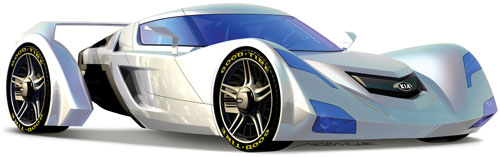
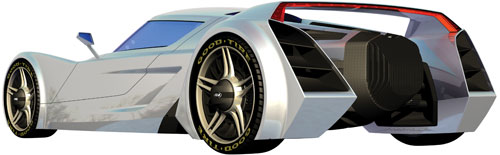
practical too. KIA
Sidewinder hybrid for 2008 - powered by a natural gas turbine with
electric drive motors in each wheel Many
of today's electric vehicles are capable of acceleration performance
which exceeds that of conventional gasoline powered vehicles. Electric
vehicles can utilize a direct motor to wheel configuration which
increases the power deliverability to the wheels. Having multiple motors
connected directly to the wheels allows for each of the wheels to be
used for both propulsion and as braking systems, thereby increasing
traction. In
some cases, the motor can be housed directly in the wheel, such as in
the Whispering Wheel design, which lowers the center of gravity and
reduces the number of moving parts. When not fitted with an axle,
differential or transmission, many electric vehicles have greater torque
availability, which goes directly to accelerating the wheels. A single
gear design in some electric vehicles eliminates gear shifting, giving
the newer electric vehicles both smoother acceleration and braking. This
also allows higher torque at wide rpm levels. Nonetheless, top
speed and total possible drive-train efficiency are severely limited by
the lack of a gearbox. For example, the Venturi Fetish delivers supercar
acceleration, yet is limited to a top speed of only 100mph. There
are no currently available technologies which can provide all of the
energy required for the life of a BEV car. This means that all BEV cars
must be refuelled by periodic charging of the batteries. BEVs
most commonly charge from the power grid, which is in turn generated
from a variety of domestic resources — primarily coal, natural gas,
and nuclear. Home power such as roof top photovoltaic panels, microhydro
or wind can also be used. Electricity can also be supplied with
traditional fuels via a generator. The
range of a BEV depends greatly on the number and type of batteries used.
The weight and type of vehicle also has an impact just as it does on the
mileage of traditional vehicles. Conversions usually use lead-acid
batteries because they are the most available and inexpensive, such
conversions generally have 20 to 50 miles (30 to 80 km) of range and are
built to satisfy the drivers' individual needs. Production EVs with
lead-acid batteries are capable of up to 80 miles (130 km) per charge.
NiMH chemistries have high energy density and can deliver up to 120
miles (200 km) of range. Lithium
ion equipped EVs have been claimed in press releases to have 250-300
miles (400-500 km) of range per charge[7].
EVs can also use pusher trailers or genset trailers in order to function
as a hybrid vehicle for occasions when unlimited range is desired
without the additional weight during normal short range use. The vehicle
becomes an internal combustion vehicle when utilizing the trailer, but
it allows the greater range that may be needed for limited times while
making the advantages of the BEV available for most shorter trips. In
practice most vehicle journeys of all kinds are quite short, the
majority being under 30 km (20 mi) per day. Thus, a BEV that can do 60
km (40 mi) in a day is quite practical for most trips for most users,
and a substantial additional range can be added for commuters where
charging facilities are available at the destination. Mercedes
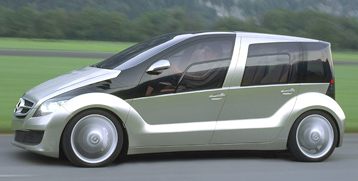
Benz F 600 Hygenius The
new F 600 HYGENIUS is the latest in the series of research vehicles from
Mercedes-Benz that point the way forwards for the future. Powered by a
zero-emission fuel cell drive with an output of 85 kW/115 hp, the
compact-class car with a family-friendly design consumes the equivalent
of 2.9 litres of fuel per 100 kilometres and has an operating range in
excess of 400 kilometres. Dr.
Thomas Weber, Daimler-Chrysler AG Board Member for Research &
Technology and Head of Development at the Mercedes Car Group, said:
"By developing the fuel cell, we are creating a new basis for
supplying energy in tomorrow's vehicles which will make a further
lasting improvement to their environmental
compatibility." "This represents a major step
towards bringing the fuel cell drive up to full production maturity, a
goal that we aim to achieve some time between 2012 and 2015." In
addition to the fuel cell technology, the Mercedes-Benz research vehicle
also showcases an operating concept with virtual displays, new-style
seats and other pioneering technologies designed to enhance safety and
passenger comfort. The
charging time is limited primarily by the capacity of the grid
connection. A normal household outlet is between 1.5 kW in the US
to 3 kW in countries with 240 V supply. The main connection to a
house might be able to sustain 10 kW, and special wiring can be
installed to use this. At this higher power level charging even a small,
7 kWh (14–28 mi) pack, would probably require one hour. Compare
this to the effective power delivery rate of an average petrol pump,
about 5,000 kW. Even if the supply power can be increased, most
batteries do not accept charge at greater than their 'charge rate' C1. Some
recent handheld device battery designs by Toshiba [8]
are claimed to be capable of accepting an 80% charge in as little as 60
seconds. Scaling this specific power characteristic up to the same 7 kWh
EV pack would result in the need for a peak of 336 kW of power from
some source for those 60 seconds. It is not clear that such batteries
will work directly in BEVs as heat build-up may make them unsafe. Most
people do not require fast recharging because they have enough time (6
to 8 hours) during the work day or overnight to refuel. As the charging
does not require attention it takes a few seconds for an owner to plug
in and unplug their vehicle. Many BEV drivers prefer refueling at home,
avoiding the inconvenience of visiting a petrol station. Some workplaces
provide special parking bays for electric vehicles with charging
equipment provided. The
charging power can be connected to the car in two ways. The first is a
direct electrical connection known as conductive coupling. This might be
as simple as a mains lead into a weather proof socket through to special
high capacity cables with connectors to protect the user from high
voltages. The second approach is known as inductive coupling. A special
'paddle' is inserted into a slot on the car. The paddle is one winding
of a transformer, while the other is built into the car. When the paddle
is inserted it completes a magnetic circuit which provides power to the
battery pack. The major advantage of this approach is that there is no
possibility of electrocution as there are no exposed conductors although
interlocks can make conductive coupling nearly as safe. Conductive
coupling equipment is lower in cost and much more efficient due to a
vastly lower component count. Individual
batteries are usually arranged into large battery
packs of various voltage and ampere-hour capacity products to give
the required energy capacities. Battery life must be considered when
calculating cost of operation, as all batteries wear out and must be
replaced. The rate at which they expire depends on a number of factors. New
scientific and empirical evidence from running individual EV conversions
shows that most of these negative factors linked to batteries connected
in series for traction application can be mitigated with good DC/DC
based Battery Management System, thermo insulation/venting, and proper
care. That also includes selecting a well balanced mix of components oriented towards specific performance properties, i.e. range, speed. For
instance a recombination type of lead-acid battery with C1 hour
discharge rate about 120Ah (equals to 220Ah C20 "marketing
rating") should be used accordingly. Therefore
the EV overall consumption of particular low/mid voltage vehicle should
not often exceed in this example 80-100% of this C1 hours rating —
this applies for more advanced battery chemistries like Li-ion with
slightly higher discharges C3-C5 as well. In this particular example,
longevity of the lead-acid battery pack will be preserved by not
discharging it in a prolonged or continuous regime above 120Ah currents. The
depth of discharge (DOD) is the recommended proportion of the total
available energy storage for which that battery will achieve its rated
cycles. Deep cycle lead-acid batteries generally should not be
discharged below 50% capacity. More modern formulations can survive
deeper cycles. In
real world use some fleet RAV4-EVs have exceeded 100,000 miles (160,000
km) with little degradation in their daily range.
Jay Leno's 1912? Baker Electric still operates on its original Edison
cells. Battery replacement costs may be partially or fully offset by the
lack of regular maintenance such as oil and filter changes and by
greater reliability due to fewer moving parts. Critics
claim that batteries pose a serious environmental hazard requiring
significant disposal or recycling costs. Some of the chemicals used in
the manufacture of advanced batteries such as Li-ion, Li ion polymer and
zinc-air are hazardous and potentially environmentally damaging. While
these technologies are developed for small markets this is not a
concern, but if production was to be scaled to match current car demand
the risks might become unacceptable. Supporters
counter with the fact that traditional car batteries are one of the most
successful recycling programs and that widespread use of battery
electric vehicles would require the implementation of similar recycling
regulations. More modern formulations also tend to use lighter, more
biologically remediable elements such as iron, lithium, carbon and zinc.
In particular, moving away from the heavy metals cadmium and chromium
makes disposal less critical. It
is also not clear that batteries pose any greater risk than is currently
accepted for fossil fuel based transport. Petrol and diesel powered
transportation cause significant environmental damage in the form of
spills, smog and distillation byproducts. Austria
Solar electric car 1991 Firefighters
and rescue personnel receive special training to deal with the higher
voltages encountered in electric and hybrid gas-electric vehicle
accidents. The
future of battery electric vehicles depends primarily upon the
availability of batteries with high energy densities, power density,
long life, and reasonable cost as all other aspects such as motors,
motor controllers, and chargers are fairly mature and cost competitive
with ICE components. The
most likely future for BEVs currently appears to be the incremental
improvements needed for hybrids. Hybrid EVs are a smaller step from
purely ICE driven cars, yet share much of the same core technology as
true BEVs. As hybrids become more refined, battery life, capacity and
energy density will improve and the combustion engine used less
(particular with PHEV). At some point it may become economic for hybrids
to be sold without their ICE, finally leading to BEVs being commonplace. Alternatively,
if fuel cells make a breakthrough neither BEVs nor hybrids will be
required. More likely fuel cells will replace the ICE in hybrid designs,
providing a large energy density, whilst a more traditional battery pack
provides the required power density. Li-ion,
Li-poly and zinc-air batteries have demonstrated energy densities high
enough to deliver range and recharge times comparable to conventional
vehicles. Their greater cost has discouraged use in commercial BEVs, but
as production increases for other markets BEVs will no doubt use them. Flywheel
energy storage is a completely different form of electrical energy
storage. It shares a lot with battery technologies and both batteries
and flywheels are used in the same applications. Recent advances in
materials and electronic control makes a flywheel 'BEV' a strong
possibility. There have been prototype electric locomotives using
flywheel storage. The
greatest fans of BEVs are those who have obtained or built and used
them. This is a self-selected group because BEVs have not been promoted
by the major manufacturers in the United States, so their enthusiasm may
be misleading. Owners of conventional gasoline vehicles, once given the
chance to live with an BEV often leave their gasoline cars sitting in
the driveway. Spouses, luke warm when the vehicle is purchased often
take over the vehicle from the purchaser once they use it. Fans point
out the following: People
can take responsibility for their own energy production with
renewables. This will reduce dependence on foreign oil and large
scale coal mining. Many electric vehicle owners and operators
express great satisfaction in this aspect of electric vehicle use,
even while acknowledging that this use can have only little effect
on these matters unless adopted more widely and produced in greater
quantities.
Battery
electric vehicles are quieter than ICE powered vehicles.
BEVs
do not produce noxious fumes around the car.
If
packs were mass-produced the charging time could be increased by
swapping the pack over with the charger. (This is not practical
currently as the battery packs are far too heavy to handle without
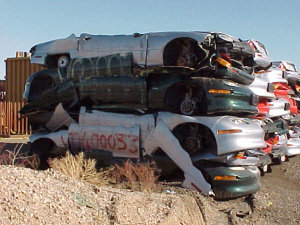
special tools) Stockpile
of crushed EV1s Some
USA EV fans have accused the three major domestic manufacturers, General
Motors, Chrysler
Corporation and Ford Motor Company of deliberately sabotaging their
own electric vehicle efforts through several methods: failing to market,
failing to produce appropriate vehicles, failing to satisfy demand, and
using lease-only programs with prohibitions against end of lease
purchase. By these actions they have managed to terminate their BEV
development and marketing programs despite operators' offers of purchase
and assumption of maintenance liabilities. They also point to the
Chrysler "golf cart" program as an insult to the marketplace
and to mandates, accusing Chrysler of intentionally failing to produce a
vehicle usable in mixed traffic conditions. The
manufacturers, in their own defense, have responded that they only make
what the public wants. EV fans point out that this response is the same
argument used by GM to justify the intensively promoted 11 mpg 6500 lb
(2,950 kg) Hummer H2
SUV. Of the various BEVs marketed by the "Big Three", only the
General Motors EV1 (manufactured by GM) and the Th!nk City (imported and
marketed by Ford) came close to being appropriate configurations for a
mass market. However, at the end of their programs GM destroyed its
fleet, despite offers to purchase them by their drivers. Ford's
Norwegian-built "Th!nk" fleet was covered by a three-year
exemption to the standard U.S. Motor Vehicle Safety laws, after which
time Ford had planned to dismantle and recycle its fleet; the company
was, however, persuaded by activists to not destroy its fleet but return
them to Norway and sell them as used vehicles. Ford also sold a few
lead-acid battery Ranger EVs, and some fleet purchase Chevrolet S-10 EV
pickups are being refurbished and sold on the secondary market. Both
Honda and Toyota also manufactured electric only vehicles. Honda
followed the lead of the other majors and terminated their lease-only
programs. Toyota offered vehicles for both sale and lease. While Toyota
has terminated manufacture of new vehicles it continues to support those
manufactured. It is actually possible to see a RAV-4
EV on the road but this is indeed a rare sight. Fastest
electric dragster The
United
States produced many electric automobiles, such as the Detroit
Electric, during the early 20th century, but production dropped to
insignificant numbers with the triumph of gasoline powered internal
combustion engine vehicles in the 1920s. In
recent years, electric vehicles have been promoted through the use of
tax credits. In California, the California Air Resources Board attempted
to set a quota for the use of electric cars, but this was withdrawn
after complaints by auto manufacturers that the quotas were economically
unfeasible due to a lack of consumer demand. However, many believe this
complaint to be unwarranted due to the claim that there were thousands
waiting to purchase or lease electric cars from companies such as
General Motors, Ford, and Chrysler in which these companies refused to
meet that demand despite their production capability. Others
note that the original electric car leases were at reduced cost and the
program could not be expected to draw the high volumes required without
selling or renting the cars at a financial loss. Since the California
program was designed by the California Air Resources Board to reduce air
pollution and not to promote electric vehicles, the zero emissions
requirement in California was replaced by a combination requirement of a
tiny number of zero-emissions vehicles (to promote research and
development) and a much larger number of partial zero-emissions vehicles
(PZEVs), which is an administrative designation for an super ultra
low emissions vehicle (SULEV), which emits pollution of about ten
percent of that of an ordinary low emissions vehicle. In
London, electrically powered vehicles are one of the categories of
vehicle exempted from the congestion charge. This is also true in all of
Norway, where zero-emission vehicles are also allowed to use the bus
lane. In most cities of the United
Kingdom low speed milk floats (milk trucks) are used for the home
delivery of fresh milk. Recent
or current production battery electric vehicles sold or leased to fleets
include: AC
Propulsion tzero Very fast two-seat sportster prototype. Four
produced.
Anthony
Electric
Arton
Birdie
Bertone
Blitz
Citicar/CommutaCar/Comuta-Van
Citroën
Berlingo Electrique
Chevrolet
S10 EV (Some sold to fleets, available on secondary market as
refurbished vehicles) S-10 with EV1 powertrain, over 100 produced only 45 sold to private owners and
survived. Currently only EVbones
in Mesa AZ restores and converts to NiMH battery packs. 2005
Chrysler
TEVan (1993-1995) and Second Generation EPIC
(1998-200?)
Commuter
Cars Tango Narrow, fast two seater (fore and aft.) Now accepting
pre-orders in the US.
Corbin
Sparrow Three-wheeled, highway capable single-seat vehicle
Detroit
Electric (1907-1939)
Elcat
(1985-2002, almost all vehicles in second-hand use)
Ford
Ranger EV (1998-2003) some sold, most leased. General
Motors EV1 Gen 1 (1996-1997), Gen II (1999-2003) Global
Electric Motorcars, LLC. GEM Quite common in Davis,
California.
Honda
EV Plus (199?-1999) Hyundai
SantaFe EVCurrently testing fast charge in Hawaii 2005
Kewet
Maranello
4cycle — Italiano
Nissan
Altra Lithium-powered hatchback; never offered (even by lease)
to consumers
Porsche
550 Spyder replica electric conversion
Peugeot
106 EV
Peugeot
Partner
Pivco
City Bee
Renault
EV Kangoo
REVA
India-built city car (40 mph top speed,) now also sold in
England as the "G-Whiz"
Sebring-Vanguard
Citicar
Sinclair
C5
Solectria
Force (Conversion, not currently in production)
Think
City (Norwegian import by Ford, lease only, all recovered and
returned to Norway)
Toyota
RAV4 EV Toyota
Force
Twike3
wheeled Swedish EV with peddal assist optiion.
Universal
Electric Vehicle Corporation Electrum series Spyder, Com V-3
Venturi
Fétish Marketed as the world's first electric sports
two-seater. Monaco
Zap
Manufactures the Xebra electric car, the U.S. only mass produced
enclosed electric vehicle
Zebra
Model Z roadster (Formerly Renaissance Tropica)
Zytec
Lotus Elise Recent
prototype EVs include: Eliica
(Electric LIthium-Ion Car) designed by a team at Keio University in
Tokyo, led by Professor Hiroshi Shimizu.
Cree
SAM
Ford
E-Ka
Lexus
EV (Featured in the film Minority
Report)
Pinanfarina
Ethos II
Renault
EV Racer
Solectria
Sunrise
Subaru
Zero EV
Suzuki
EV Sport
Maya-100
Battery: Li-ion "super"-polymer; claimed range: 360 km
Mitsubishi
Colt EV (Li-ion battery, in-wheel motors)
Volvo
3CC Three seater with lithium ion batteries
Electric
Scooter Razor Electric Bikes Venturi
"Fetish" sports car to use AC propulsion components
AC
propulsion announces plans to convert Toyota Scion xA and xB
vehicles
(items 8 and 9).
Mitsubishi,
a Japanese automobile manufacturer, announced on May 11, 2005 that
it will mass-produce its MIEV (Mitsubishi In-wheel Electric
Vehicle.) Test fleets are to arrive in 2006 and production models
should be available in 2008.
The first test car, revealed to be Colt EV, is expected to have a
range of 93 miles using lithium-ion batteries and in-wheel electric
motors. The target price of a MIEV should be around US$19,000.
No export decision has yet been made.
Plug-in
hybrid electric vehicle are being developed by calcars and Edrive.
They take a Toyota Prius, add more battery capacity and modify the
controller. Then they can get 250 mpg by plugging in at home for a
small light charge each night. http://www.calcars.org/ There
is a minor industry supporting the conversion and building of BEVs by
hobbyists. Some designers point out that a specific type of electric
vehicle offers comfort, utility and quickness, sacrificing only range.
This is called a short range electric vehicle. This type may be built
using high performance lead–acid batteries, but of only about half the
mass that would be expected to obtain a 60 to 80 mile (100 to 130 km)
range. The
result is a vehicle with about a thirty mile (50 km) range, but when
designed with appropriate weigh distribution (40/60 front to rear) does
not require power steering, offers exceptional acceleration in the lower
end of its operating range, is freeway capable and legal, and costs less
to build and maintain. By including a manual transmission this type of
vehicle can obtain both better performance and higher efficiency
than the single speed types developed by the major manufactures. Unlike
the converted golf carts used for neighborhood electric vehicles, these
may be operated on typical suburban throughways (40 to 45 mph or 60
or 70 km/h speed limits are typical) and can keep up with traffic
typical to these roads and to the short on and off segments of freeways
that are common in suburban areas. Aside
from production electric cars, often hobbyists build their own EVs by
converting existing production cars to run solely on electricity. Some
even drag race them as members of NEDRA. Universities such as the
University of California, Irvine even go so far as to build their own
custom electric or hybrid-electric cars from scratch. A
non-profit program "CalCars"
at the University of California, Davis, is attempting to convert a
hybrid Toyota
Prius automobile to operate as a plug-in hybrid electric vehicle (PHEV)
through the installation of additional batteries and software
modifications. Such a vehicle will operate as would a pure electric for
short trips, taking its power from household and workplace rechargers.
For longer trips the vehicle will operate as it does at present—as a
"strong" hybrid vehicle. A prototype (using sealed lead-acid
batteries) is undergoing tests. It is expected that a production
conversion would use a more advanced battery. (Advanced batteries are
under development and soon for production in the support of hybrid
vehicles.) They are currently soliciting donations of additional
vehicles and funds for this project. Battery
electric vehicles are also highly popular in quarter mile (400 m)
racing. The National Electric Drag Racing Association regularly holds
electric car races and often competes them successfully against exotics
such as the Dodge
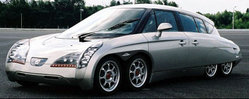
Viper. Eliica
prototype Japanese
Prof. Dr. Hiroshi Shimizu from Faculty of Environmental Information
of the Keio University created the limousine of the future: the Eliica
(Electric Lithium Ion Car) has 8 wheels with electric 55 kW
hub motors (8WD) with an output of 470 kW and zero emissions.
With a top speed of 190 km/h and a maximun reach of 320 km
provided by lithium-ion-batteries. See the video at [20]
German
Umweltbrief [21]
want to convert an old-timer car into full electric drive with 4
wheel hub motors; a retro car for the 21th century called electro4.
This drive is nearly free of abrasion and maintenance and very
reliable. Further advantages are optimal capability of acceleration
and best traction through individual control of the wheels. Also the
power is generated in the place where its used. Gearbox, kardan
shaft and drive shaft become unnecessary, which means less weight.
Even an old car can get a torque
of 1000 N·m.
This 4WD is very silent. There is no vibration and no motor
cold-running, the full energy is available immediately. Also small
cars can get this system. All is combinable with anti-block system,
anti-slip system, stability system, etc., climate control with a/c,
heating/cabin, pre-conditioning etc. [22] EUROPEAN
EV MANUFACTURERS INCLUDE: -
Audi -
BMW -
Citroen -
Fiat -
Ford -
Lotus -
Mercedes -
Peugeot -
Renault -
Seat -
Smart EV
LINKS: Megawatt
Motorworks Features the emerging scene of high power electric
vehicle motor sports.
The
Hydrogen Expedition Around the world on an electric vehicle
Electric
Vehicle Discussion List for owners and builders of conversions and
other EVs
EV
Supersite The world's largest online electric vehicle conversion
diary. This popular site sees visitors from between 8 to 16 time zones
per day. Hundreds of fully illustrated web pages describe the conversion
of a Saturn sedan to an emissions-free battery-electric vehicle.
Comprehensive and informative...
EV
engineer Steven Kent's site promoting his self published book, Kar
Kaptains Kry, "Kalamity!" This book, the first of
three, describes and justifies the short range high performance EV and
another type combining internal combustion and mains-recharged batteries
that he calls a "glider" (now commonly called a "plug in
hybrid") and includes engineering and marketing analysis for mass
production.
Alternative
Fuel Vehicle Training From the National Alternative Fuels Training
Consortium. http://www.proev.com:80/
ProEV Inc.
is a sister company to Lee Racing, a professional race team and race car
prep shop located in Miami, Florida.
7735 NE 8th Ave, Miami, FL 33138, USA Tel. 305-610-6412
See
also "http://www.driveclean.ca.gov/"
for an official California site on ZEVs and PZEVs. A
page on this site, "http://www.driveclean.ca"
will also list the available cars in various categories, especially
informative if you are looking for an electrically powered city car (that
page has no entries). The
world's fastest street legal electric car Experts
say electric cars should be part of research plans for automakers
— "That's the advice of a panel of technical experts representing
the National Academy of Sciences. They say government and industry
researchers should examine battery electric vehicles as an alternative
to cars and trucks powered by hydrogen fuel cells."
Altair
gets order for 1000 kg of lithium titanate spinel electrode
nanomaterials [23]
[24]
[25]
[26]
Toshibas
High-Rage (50C) Li, scheduled for 2006 production [27]
San
Francisco Chronicle: Owners
charged up over electric cars, but manufacturers have pulled the plug
4/24/2005
The
Electric-Car Slide, October 22, 2003
Slim
Fit For The Freeways Oct 2, 2003
tzero
earns a 3.40 GPA Sept. 29, 2003
Stopping
Traffic, Rick and Bryans Tango July 27, 2003
tzero
exciting article in NY Times Sep 20, 2003 HybridCars.com
- includes articles on hybrid electric cars and their impact on the
environment.
Howstuffworks:
How Hybrid Cars Work
- features an illustrated description of the
parallel hybrid powertrain of the Toyota Prius.
FutureTruck
- information about the competition which challenges students to modify
SUVs into fuel-efficient hybrid-electric vehicles.
GreenHybrid.com
- hybrid electric vehicle resource offering forums, articles, car
comparisons, and performance statistics.
Care2.com:
Hybrid Cars
- gives an overview of how hybrid cars work.
UC
Davis Hybrid Electric Vehicle Research Program
- advanced Hybrid
Vehicle research group.
Eartheasy:
Hybrid Cars
- contains news and information about the various hybrid
cars in production as well as upcoming developments.
National
Renewable Energy Laboratory (NREL): Hybrid Electric and Fuel Cell Vehicles
- works toward developing hybrid electric vehicles (HEVs) and fuel cell
vehicles (FCVs) with an eye towards moving them from research and
development to the marketplace.
Wikipedia:
Hybrid Car
- overview including the history, technology, types, and
perks of automobiles powered by internal combustion engines, electric
motors, and battery rechargers.
California
State University, Chico - Advanced Vehicle Research & Development
- students designed and built a hybrid electric car.
Energy
Quest: Hybrid Vehicles
- short summary of the new type of cars that
save energy.
MSN
Money: Hybrid Cars
- helps you decide whether purchasing a hybrid
vehicle is the right choice for you over traditional combustion engine
cars. Contains information and pricing on current models, the tax
advantages of buying, and more.
Wired
News: Hybrid Mileage Comes Up Short
- hyperlinked article that
examines the shortcomings of hybrid vehicles.
All
About Hybrid Cars
- offers a hybrid car buyer's guide ebook as well as
model comparisons, related news articles, FAQs, and a directory of web
resources.
Electromotive
Hybrid Electric Development
- introduces the Electromotive Strategic
Power Assist Hybrid System.
Hybrid
Car Information
- offering hybrid electric car news and a guide to
current and future hybrid models.
U.S.
Department of Energy: Hybrid Electric Vehicles
- contains information
about HEV benefits, availability, maintenance, and history.
Hybrid-Cars-Guide.com
- offers advice on choosing hybrid cars and information on hybrid vehicle
technologies.
Dodge
Viper v Tzero electric car FORMULA
E - Formula E
is a class of auto racing sanctioned by the Fédération
Internationale de l'Automobile (FIA). The "formula",
designated in the name, refers to a set of rules with which all
participants' cars must comply. Formula E is intended to be the
highest class of competition for one-make, single-seat,
electrically-powered racing cars. The series was conceived in 2012,
with the inaugural championship to be held in 2014. Demonstration
events are planned for the second half of 2013.
RACING
DRIVERS INDEX
ACCEPTANCE ISSUES
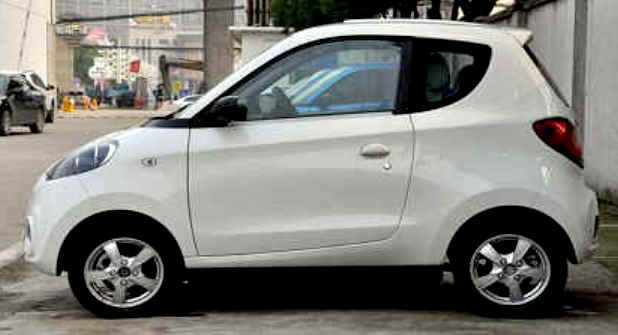
The Achilles heel of electric cars is range and price. Everybody wants one, especially those who live in congested cities. The very latest car with a respectable city range and very fast charge time is the Kity 301, seen below in white.
The Kity 301 is a two seat, two door hatchback that could retail around the £7,500 mark with car tax, to make it one of the most economical to buy city cars in the UK. The range is likely to be 50-60 miles on a single charge at city speeds, with fast charging in around 20 minutes and a top speed more than enough to cope with fast moving city traffic.
HOME CHARGING POINTS & FAST CHARGE
You may be able to get a home charging outlet fitted free of charge, subject to conditions.
GOVERNMENT INCENTIVES
There may be Goverment backed incentive schemes to help offset the cost of replacing your existing petrol or diesel car.
CITY EV CARS - COMPARISON CHART @ WIKIPEDIA
HIGHWAY CAPABLE EVs @ WIKIPEDIA
EV UNIT COST COMPARISON & OTHER DETAILS @ WIKIPEDIA
Please click on the links above to find out about these famous automotive makers. If your company is not included and you would like to be listed, please let us know.
A taste for adventure capitalists
SMARTCHARGER - Potentially the world's fastest electric car: 400mph using energy from nature. Featuring built in battery swapping system, charged using renewable solar energy. A project in waiting in PR terms.
|
||||||||||||||||||||||||||||||||||||||||||||||||||||||||||||||||||||||||||||||||||||||||||||||||||||||||||||||||||||||||||||||||||||||||||||||||||||||||||||||||||||||||||||||||||||||||||||||||||||||||||||||||||||||||||||||||||||||||||||||||||||||||||||||||||||||||||||||||||||||||||||||||||||||||||||||||||||||||||||||||||||||||||||||||||||||||||||||||||||||||||||||||||||||||||||||||||||||||||||||||||||||||||||||||||||||||||||||||||||||||||||||||||||||||||||||||||||||||||||||||||||||||||||||||
|
The
content of this website is copyright © 1991 and 2019 Electrick
Publications. All rights reserved. The bluebird logo
|
||||||||||||||||||||||||||||||||||||||||||||||||||||||||||||||||||||||||||||||||||||||||||||||||||||||||||||||||||||||||||||||||||||||||||||||||||||||||||||||||||||||||||||||||||||||||||||||||||||||||||||||||||||||||||||||||||||||||||||||||||||||||||||||||||||||||||||||||||||||||||||||||||||||||||||||||||||||||||||||||||||||||||||||||||||||||||||||||||||||||||||||||||||||||||||||||||||||||||||||||||||||||||||||||||||||||||||||||||||||||||||||||||||||||||||||||||||||||||||||||||||||||||||||||